Ph.D. Graduate Q&A: Xinyuan Cao
As a machine learning (ML) theorist, Xinyuan Cao spent her Ph.D. at Georgia Tech digging into the mathematical foundations of artificial intelligence (AI).
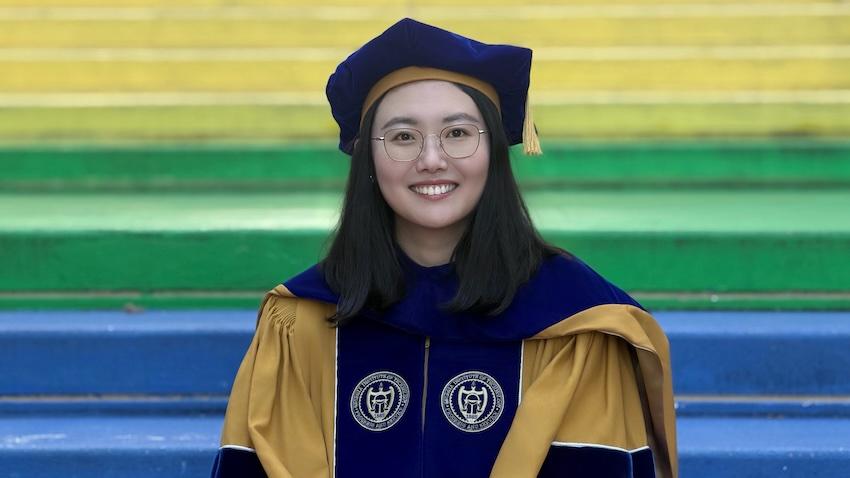
Cao's work has earned her recognition, including the 2024 J.P. Morgan AI Research Ph.D. Fellowship and the 2023 Georgia Tech ARC Fellowship. Last week, she joined the Class of 2026 as she received her Ph.D. in machine learning.
Before starting her next role in AI research, Cao shared the ideas and people that defined her time at Tech.
What did your research focus on?
I work on ML theory, which focuses on building foundations for ML algorithms. We try to understand why certain algorithms work or don’t work from a theoretical perspective. This ensures a better underlying understanding of those algorithms.
What made you interested in studying that topic?
When I was starting my Ph.D., a lot of new AI and ML technologies were coming out , and I was really interested in understanding them. I feel it’s meaningful for us to step back and think about more foundational things. I also like that the research involves a lot of theory that comes from geometry or algebra. Some of these theories could be from 100 years ago, but you can use them to show an algorithm that was just proposed this year.
Why did you choose to study at Georgia Tech?
When I talked to professors here, we found many common interests in the field of machine learning theory, and that was very exciting. Georgia Tech’s CS rankings and the great weather here were also big factors.
Are there any specific people who helped you during your Ph.D. journey?
Definitely my advisor, Santosh Vempala. We’re working in an area that is a combination of very traditional theory and modern technologies, and this makes it hard to define a clear question to focus on. Santosh has been very helpful throughout that experience, and working together has been really nice.
I’ve also worked with Jacob Abernethy and appreciate learning from him. He has an ML theory reading group that I’ve attended frequently, and that’s a good memory for me.
What advice would you give someone interested in pursuing a Ph.D.?
I think it’s important to find the problem that you are truly interested in. In research, you may reach a point where neither you nor your advisor knows how to proceed, and it is unclear whether the problem is even solvable. If you’re not working on something that you really care about, it can be hard to push through and find the motivation to keep working on it and solve it.
What are your plans after graduation?
I have accepted a postdoctoral fellowship at the Vector Institute, where I will continue my AI research.