New Faculty Joins Tech to Advance Medicine and Science through AI
As doctors increasingly rely on computational approaches to examine and treat patients, Georgia Tech is building its expertise at the intersection of healthcare, computer vision, and artificial intelligence (AI).
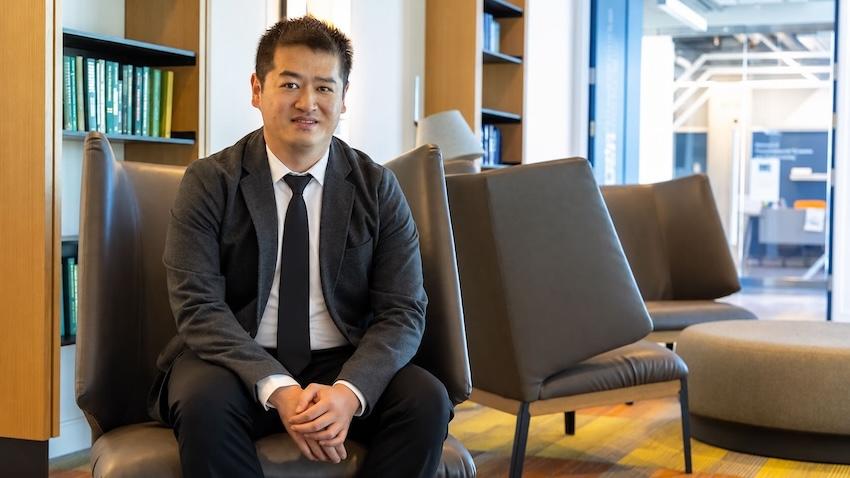
Jiayun (Peter) Wang began his tenure-track career on Oct. 15 as an assistant professor in the School of Computational Science and Engineering (CSE).
At Georgia Tech, Wang will develop new AI tools to help doctors make better use of complex medical data. His research aims to transform information from medical images, clinical measurements, and patient records into clearer insights that improve diagnosis, treatment, and patient care.
“I’m excited to build a lab at Georgia Tech, and to work with students and collaborators on new ideas,” Wang said. “I hope our research can connect fundamental advances in AI with real challenges in healthcare and science.”
Before starting at Georgia Tech, Wang conducted postdoctoral research at Caltech and worked as a senior research scientist at Accenture. He earned his Ph.D. in 2023 from the University of California, Berkeley.
Much of Wang’s healthcare research builds on computer vision, which enables machines to interpret images and videos.
For example, lung ultrasound is a fast, portable, and radiation-free way to check breathing problems. However, a drawback is that images can be hard to read.
Wang led the development of LUNA, an AI method that converts raw ultrasound signals into maps showing how air is distributed in the lungs. This approach makes bedside lung exams more consistent and easier to interpret.
MRI is another medical imaging procedure that Wang has studied and improved using AI.
A shortcoming of MRI is it takes longer times for both scanning and analyzing results. Lying flat and motionless in a scanner can be uncomfortable for patients, and waiting for results can be stressful when stakes are high. Time is a constraint for providers when it comes to scheduling the procedure and consulting experts while reviewing scans.
To overcome this, Wang worked on a team that built a single, flexible AI model that reconstructs high-quality MRI images from fewer measurements across different scanning settings. Along with enabling faster scans, the approach preserves the details doctors need to make informed decisions.
During robot-assisted surgery, trainees receive guidance from experienced surgeons. However, it is difficult to know what advice improves techniques. A surgical-training study that Wang co-authored combined video and spoken feedback to assess trainee learning.
Dry eye is one of the most common reasons people visit eye clinics, yet the condition is difficult to assess.
With collaborators at UC Berkeley, Wang has studied AI approaches to analyze both patient information and images of tiny glands in the eyelids. These studies contributed to AI tools that assist in diagnosing ocular surface diseases and predicting dry eye onset based on lifestyle factors.
Beyond healthcare, Wang also works to make AI easier to train and use. His research helps models learn from images without extensive human labeling and build strong systems that require less computing power.
“Medical measurements are often noisy, incomplete, or difficult to interpret. Yet they can carry information that matters for doctors and patients,” said Wang.
“I’m motivated by the opportunity to combine what we know about the physical world with new learning methods to build AI systems that are more reliable and useful.”
Looking ahead, Wang is building the SWI Lab (science, world models, and intelligence) at Georgia Tech.
The lab develops AI “world models” that learn how physical and biological systems behave, predict how they change, and help researchers draw insights from incomplete measurements. This work connects fundamental AI advances with challenges in medicine and science.
Ph.D. students Xinsong Feng and Wentao Zhou joined SWI Lab this fall as its inaugural members. The lab welcomes prospective students, research interns, and visitors interested in world models and Wang’s work.
“The opportunity to work across computing, engineering, and science attracted me most to Georgia Tech,” Wang said.
“The most interesting problems often require both new AI ideas and deep knowledge of their applications. I look forward to studying those problems through new relationships and collaborations.”