College's Expanded GTSI Offering Showcases Creativity, Challenges Computing Myths
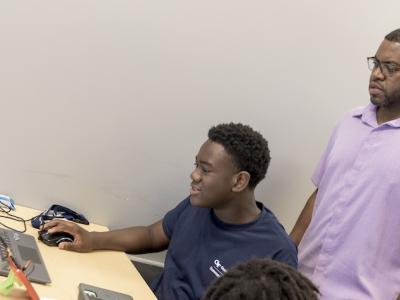
For more than 100 rising 11th-grade students attending this year’s Georgia Tech Summer Institute (GTSI), computing wasn't presented as a single career path or a fixed set of programming languages. Instead, students discovered the creative side of computing.
GTSI brings talented students from across the state to campus for a weeklong taste of college life.
Along with learning about academic programs and scholarship opportunities, GTSI offers participating students – many from rural and under-resourced communities – hands-on STEM experiences.
Discovering a Different Side of Computing
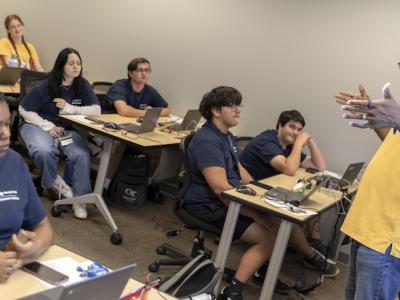
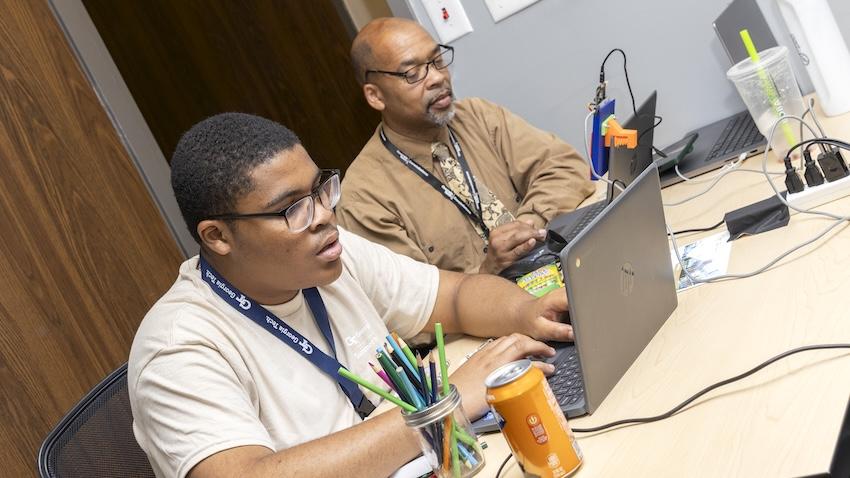
In its second year of participating in GTSI, the College of Computing broadened its partnership with the Center for Education Integrating Science, Mathematics, and Computing (CEISMC) this summer, offering two full-day, interactive experiences that integrated creativity and computational thinking.
"The College of Computing first participated in 2025 and is excited to build on that partnership," said Aneesah Allen, senior education outreach manager, who coordinated the College's involvement with CEISMC.
"Our goal is to create a memorable experience that helps students see themselves in computing while learning new skills in a fun, engaging way."
Hands-On Learning, Real-World Connections
To achieve this goal, the GT Computing-led sessions gave GTSI students the opportunity to experiment with artificial intelligence (AI) and machine learning, explore physical computing, and discover how technology intersects with:
- Arts & entertainment
- Sports
- Interactive media
- And more
Sababu Barashango and Terry Foster, CS instructional specialists and research associates at the College’s Constellation Center for Education in Computing, along with Cedric Stallworth, GT Computing assistant dean for outreach, led the College’s participation in this year’s GTSI.
For Barashango, the interactive sessions – focused on computer science (CS) and computational media (CM) – were designed to broaden students' understanding of what computing can be.
"The College of Computing and its Constellations Center for Education in Computing are partnering with CEISMC to help high school students understand the many possibilities computer science and computational media offer," said Barashango. "The students were deeply engaged in the interactive sessions.
"The content ranged from an introductory icebreaker using Google Maps and pixel art to block coding and physical computing, and finally to AI and machine learning."
Along with presenting computing’s creative side and emphasizing hands-on participation, the GT Computing-led sessions were designed to challenge long-held assumptions about who belongs in computing and what skills the field requires.
"The experiences in our sessions directly challenge the myth that you can't be both creative and logical," Barashango said.
Expanding Students' View of Computing
Foster believes that introducing students to all aspects of computing before they make decisions about college can help them see opportunities well beyond what they might have considered.
"Learning about CS and CM pathways broadens their view of computing and allows them to apply computing in fields they care about," Foster said.
He pointed to computational media as an especially powerful gateway because it integrates technical and creative thinking.
"When speaking specifically about CM, which is an excellent entry point into computing, students can be both creative and technical, not just one or the other," Foster said.
The GT Computing-led sessions also encouraged students to think beyond traditional technology careers.
"One of the key messages we shared with students was that earning a computer science degree does not mean they have to become software engineers," Foster said.
"We emphasized the wide range of computing careers available, including fields such as sports technology, film production, and interactive media, in which CS and CM skills are highly valued."
Building Tomorrow's Computing Workforce
Despite the success of the College’s GTSI session, Barashango recognizes that the goal of helping students see themselves in computing extends beyond a single summer program.
“Introducing students to computational thinking early can help prepare them for whatever path they choose,” he said. "Regardless of their career choices, their lives will continue to be affected by and integrated with computer science.”
"If they do not develop computational thinking and skills, they will be left behind in the technology and wealth gap."